【In-depth Study】OLED Inkjet Printing Patent Technology
This paper analyzes the patent application status of inkjet technology for OLED film formation, examines the global distribution of related patent technologies and the key applicants, deeply explores the key technical branches of OLED inkjet printing, and based on this, predicts the future development trend of OLED inkjet printing technology, with the aim of providing reference for domestic innovation entities' patent layout and technological research and development.
The new display technology has developed into a leading pillar industry of the new generation of information technology, and is one of the key directions for the strategic development of emerging industries in the era of informatization and intelligence in China. With the rapid progress of information technologies such as "Internet +", artificial intelligence, and wearable devices, display devices, as information windows, have been required to meet demands for flexibility, lightness, energy saving, foldability and curvature, and ultra-large size. As a result, new display technologies have emerged, such as Organic Light-Emitting Diode (Organic Light-Emitting Diode, abbreviated as "OLED"). Inkjet printing technology, due to its high material utilization rate and the ability to achieve large-scale production, is considered an important method for realizing mass production of large-sized OLED display devices.
This article analyzes the patent layout and key technologies of OLED inkjet printing technology, providing a detailed overview of the overall development status of OLED inkjet printing technology. The aim is to offer some insights for the development of OLED technology in China.
Analysis of Patent Application Status
1. Analysis of Global Patent Annual Application Status
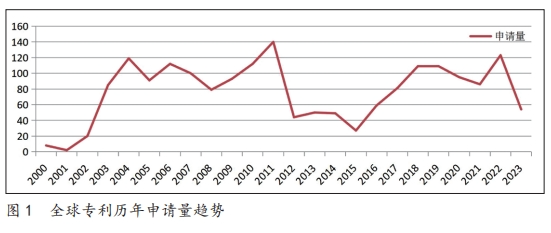
Although the manufacturing and coating of OLEDs have a long history, achieving OLED manufacturing through inkjet technology is a relatively new technique. The patent applications mainly concentrated after 2003. As shown in Figure 1, the patent application volume was generally high from 2003 to 2011, decreased from 2012 to 2016, and then gradually increased. That is to say, the OLED manufacturing technology began to show a vigorous development trend in 2003. During this period, a large number of OLED manufacturers began to explore and actively use new coating methods - inkjet printing - to achieve OLED coating and manufacturing. This technology entered a prosperous development stage in 2011. With the increasing maturity of OLED technology and the gradual popularization of its applications, the manufacturing of OLED has maintained stable development since 2017. At the same time, the inkjet coating technology has become increasingly mature and developed. Although the patent application volume in 2023 shows a downward trend compared to the past, the reason for this might be that some of the patents applied for in 2023 have not been made public yet.
2. Analysis of Key Global Applicants and Application Volume Status
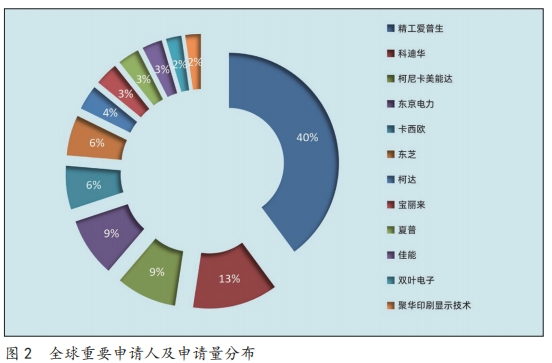
As shown in Figure 2, the company with the highest application volume and a significant lead is Seiko Epson. Followed by it are Kodihua, Konica Minolta, Tokyo Electric Power, Casio Toshiba, etc. Among them, Seiko Epson's application volume accounts for 38%, Kodihua accounts for 13%, and Konica Minolta and Tokyo Electric Power each account for 9%. The major applicants of the global OLED inkjet coating patent technology mainly come from Japan and the United States. This is mainly because the inkjet printing technology in Japan and the United States has always been at the leading level, and Seiko Epson is the leading enterprise in inkjet printing technology and a key force in technological research and development. It holds a very important position in inkjet printing technology. Under the trend of the vigorous development of OLED, in addition to Seiko Epson and Kodihua, other inkjet printing enterprises and OLED manufacturing enterprises have also begun to pay attention to the research and application of OLED coating technology through inkjet printing.
Key Technical Analysis
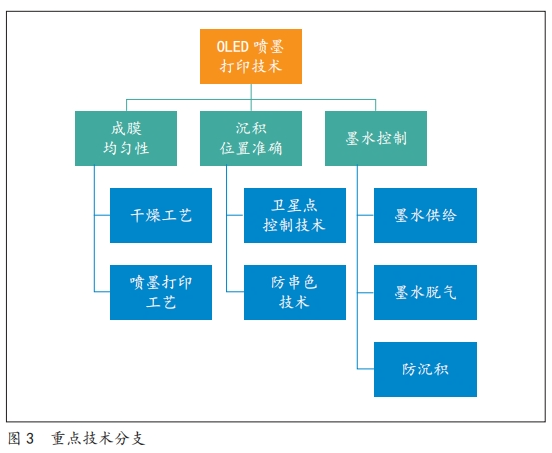
By collecting, indexing and organizing the patent documents related to OLED inkjet printing technology, and analyzing the sample patents involving OLED inkjet printing, it was found that the current research focus of OLED inkjet printing technology mainly includes the following aspects: film formation uniformity, deposition position accuracy, and ink supply technology (as shown in Figure 3).
1. Film Formation Uniformity Control Technology
When preparing OLED light-emitting panels using inkjet printing technology, the uniformity of the formed film will significantly affect the performance of the device, such as brightness uniformity, lifespan, efficiency, etc. In severe cases, it may even cause short circuits and failure to emit light. Therefore, ensuring the uniformity of the film thickness of the functional layer formed by inkjet printing is a key requirement for inkjet printing.
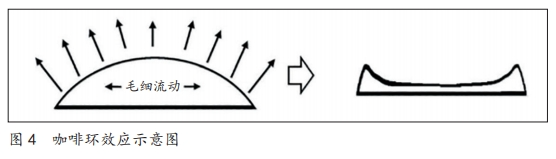
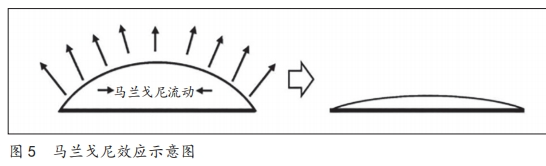
The two most common types of uneven film formation are the coffee ring effect and the Marangoni effect. Among them, the coffee ring effect is a common phenomenon during inkjet printing, as shown in Figure 4. When ink droplets fall onto the substrate or pixels, due to the shape of the ink droplets, that is, due to the formation of the surface tension variation curve, the evaporation rates of the smaller volume and smaller area central part and the larger volume and larger area edge part of the ink droplet are different. Therefore, the edge part of the ink dries faster. As the solvent in the edge part continuously evaporates, the solid content distribution of the center part and the edge part becomes different, resulting in a concentration gradient difference, thereby causing the capillary compensation flow phenomenon of solvents from the center part to the edge part. This flow of solvents is bound to carry some solutes to the edge part, leading to an increasing amount of solute in the edge part, and ultimately causing the formation of the coffee ring effect. The Marangoni effect is also a common phenomenon during inkjet printing. The reason for the occurrence of the Marangoni effect is that liquids with high surface tension have a stronger pull on liquids with low surface tension around them, resulting in a surface tension gradient, causing the liquid to flow from the area with low surface tension to the area with high surface tension. As shown in Figure 5, the surface tension gradient causes the Marangoni flow to occur, transporting the solute from the edge to the middle area, resulting in a "thicker in the middle and thinner at both ends" membrane surface.
At present, the patented technologies used to improve the uniformity of film formation mainly include two aspects: improving the drying process and improving the inkjet printing process. The improvement of the drying process mainly includes controlling the drying temperature, using auxiliary drying gases during spraying, condensation technology, solvent blending technology, and adding nozzle auxiliary structures, etc. As for the inkjet printing process, the ideal state for forming a uniform film layer is that each nozzle on the printing head uniformly sprays ink droplets of the same volume into each pixel pit, thereby ensuring uniform thickness of the film in the pits. However, in the actual inkjet printing process, affected by the printing accuracy of the inkjet head, such as different volumes of ink droplets being ejected from the nozzle, and the droplet falling angle deviating from the ideal falling angle, there will be differences in the ink volume between pixel pits. Currently, the technologies for improving the uniformity of film formation through inkjet printing mainly include controlling inkjet parameters, changing ink droplet viscosity, adjusting inkjet speed, and adjusting ink droplet volume, etc.
2. Sedimentation Position Accuracy Control Technology
It is well known that the film formation quality of the organic light-emitting pixels in the structure of OLED display panels directly affects the display effect of the panels. The organic light-emitting pixels are composed of a series of pixel pits arranged in a matrix. During the film formation process, how to accurately form the film in the pixel pits is an important aspect of OLED manufacturing technology. With the application of inkjet printing technology in OLED production, accurately forming inkjet dots in the required film-forming pixel pits is currently the key to OLED film formation technology. Inaccurate inkjet positioning can easily cause wave patterns, color mixing and other phenomena in OLED display panels, thereby affecting their display performance. To address this issue, researchers have explored and improved the following aspects.
2.1 Satellite Point Control Technology
When the inkjet printing process occurs in the middle of the printing area, the splashed satellite droplets still fall onto the printing area. However, when the inkjet printing process takes place at the edge of the printing area, the splashed satellite droplets will fall outside the printing area instead of on the printing area itself. Such satellite droplets will have adverse effects on the subsequent production processes.
In order to avoid any impact on product quality caused by satellite points, the current patented technologies mainly focus on the following two aspects:
One approach is to reduce the occurrence of satellite droplets. For instance, the patent document CN201921227414 discloses a method where a flow-blocking section is set within the channel of the nozzle. During the process of the printing liquid flowing from the accommodating cavity of the substrate through the channel inlet to the outlet, it passes through the sub-channels of the flow-blocking section and comes into contact with the second inner wall of the flow-blocking section, thereby increasing the contact area between the printing liquid and the inner wall of the nozzle. At the outlet position, the printing liquid is ejected as droplets, which can reduce the satellite effect of the droplets.
Second, the generated satellite droplets are eliminated. For example, the patent document CN202110406779 discloses a piezoelectric inkjet system applied to ink droplets for printing and its optimization method. Specifically: The central control system collects the falling images of ink droplets after passing through the multi-channel heating device through the ink droplet monitoring system and analyzes whether there are still satellite droplets based on the falling images. If there are still satellite droplets, the central control system obtains the nozzle number of the nozzle that ejects the satellite droplet from the falling images and adjusts the temperature of the heating channels corresponding to the nozzle in the multi-channel heating device through the temperature control adjustment device to eliminate the still existing satellite droplets. Eventually, almost all the satellite droplets that affect the printing accuracy are completely evaporated, leaving the main ink droplets with finer dimensions to participate in substrate deposition, which greatly improves the printing accuracy.
2.2 Color bleeding prevention technology
As the name suggests, anti-solvent bleeding refers to preventing liquid from entering the wrong color wells. Currently, the patented technologies used to enhance the anti-solvent bleeding performance mainly cover the following directions:
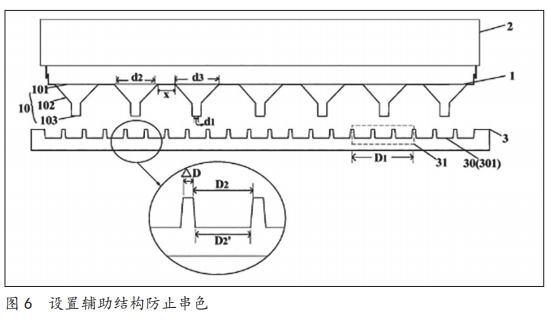
One approach is to establish auxiliary structures. For instance, patent document CN201710953212 discloses a technical solution that prevents color mixing by setting a liquid guiding component. As shown in Figure 6, specifically, the multiple liquid guiding slots 10 of the liquid guiding component can allow the liquid to enter from the inlet end 101 and then flow out from the outlet end 103. The slot wall 102 connecting the inlet end 101 and the outlet end 103 can play the role of transmitting the liquid, thereby preventing the liquid from deviating from the direction of the outlet end 103. This liquid guiding component can be applied in inkjet printing. The aforementioned liquid can be the ink sprayed by inkjet printing. By using the liquid guiding component, the movement direction of the ink after spraying can be precisely controlled, improving the accuracy of inkjet printing. Compared with the existing technology that directly sprays ink from the nozzle, it avoids the influence of adverse external factors on the ink after it exits the nozzle and the problem of printing equipment having low precision resulting in misalignment, solving the problem that display devices prepared by inkjet printing are prone to adjacent pixel color mixing or pixel loss in the existing technology, and achieving the effect of improving the accuracy of inkjet printing.
Second, improve the performance of the substrate. As the carrier for receiving the droplets, the performance of the substrate also affects the accuracy of the droplet deposition position. Therefore, improving the performance of the substrate is an important means to enhance the accuracy of the droplet deposition position.
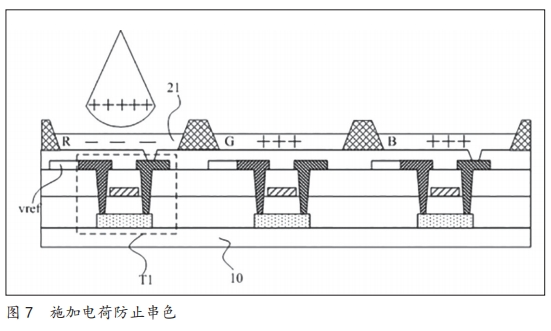
The third step is to apply an electric charge to the ink droplets, making them carry the desired charge. This is achieved through the electric field to improve the accuracy of the ink droplet positions and thereby prevent color bleeding. For example, patent document CN201710867408.2 discloses a technical solution for preventing color bleeding by applying an electric charge, as shown in Figure 7.
2.3 Ink Control Technology
Using printing equipment to produce OLED and organic thin-film transistor display products has the advantages of high material utilization and a short production cycle. However, due to the differences in the components of the ink used for OLED preparation compared to ordinary graphic printing ink, different situations may occur during actual production. For example, due to the high viscosity of the ink, it is difficult to supply, causing equipment failures; due to the presence of bubbles in the ink, printing quality is poor; using suspension ink such as nano-silver or ink that easily separates after dissolution, it is prone to clog the printing nozzle and a series of other problems.
(1) Ink Supply
Due to the inherent characteristics of the ink used in OLED inkjet printing, the ink supply method is often different from that of ordinary printer models. As a result, some patent applications related to the supply of OLED ink have emerged.
(2) Ink Degassing
If bubbles are mixed in the ink, it often leads to problems such as non-spreading or skewed spraying, seriously affecting the spraying accuracy. To avoid poor printing caused by the presence of bubbles, the patent document CN202022038582 discloses an ink storage device. This ink storage device is used in inkjet printing devices. It forms an ink storage space by using an inner container made of a permeable membrane inside the housing. A first sealed space surrounding the inner container is formed between the housing and the inner container. A first vacuum pump is used to evacuate the first sealed space, creating a negative pressure within it. During the storage of ink in the ink storage space or the flow of ink through the ink storage space, due to the presence of the negative pressure, gas molecules penetrate through the side wall of the inner container into the first sealed space and are then removed, thereby providing a good defoaming effect on the ink.
(3) Anti-deposition
Using suspension ink such as nano-silver or ink that easily separates after dissolution can easily clog the printing nozzle, causing equipment malfunctions. To solve these problems, patent document CN201720235727 discloses a spray device for improving the fluidity of the liquid and reducing the occurrence of liquid precipitation and nozzle blockage. The device comprises: a spray nozzle connected to the storage chamber; a circulation pipeline connected to the storage chamber; and the circulation pipeline and the storage chamber forming a circulation loop for the liquid. By setting a circulation pipeline connected to the storage chamber, the liquid in the storage chamber can be circulated, thereby reducing the occurrence of non-dissolved particles precipitating and blocking the nozzle.
This article reviews the global patent application volume and key applicants of OLED inkjet printing technology, to understand the current patent layout of this technology. It conducts technical indexing on the analysis samples and discovers that currently this technology mainly involves three key technical branches: film formation uniformity, deposition position accuracy, and ink control technology. Among them, regarding film formation uniformity, the current patent technologies mainly improve the drying process and the inkjet printing process; regarding deposition position accuracy, the main patent technologies include the control of satellite points and anti-collapsing color technology; regarding ink control technology, the main patent technologies include ink supply, ink degassing, and anti-deposition.